Hear us, O deathless gods, who witnessed the birth of stars,
who have watched the generations of men rise and pass into dust.
Look now upon this gathering, and bear witness to our judgment.
Grant us your blessing, that neither fear may master our hearts,
nor pride blind our eyes to the darkness beyond our knowledge.
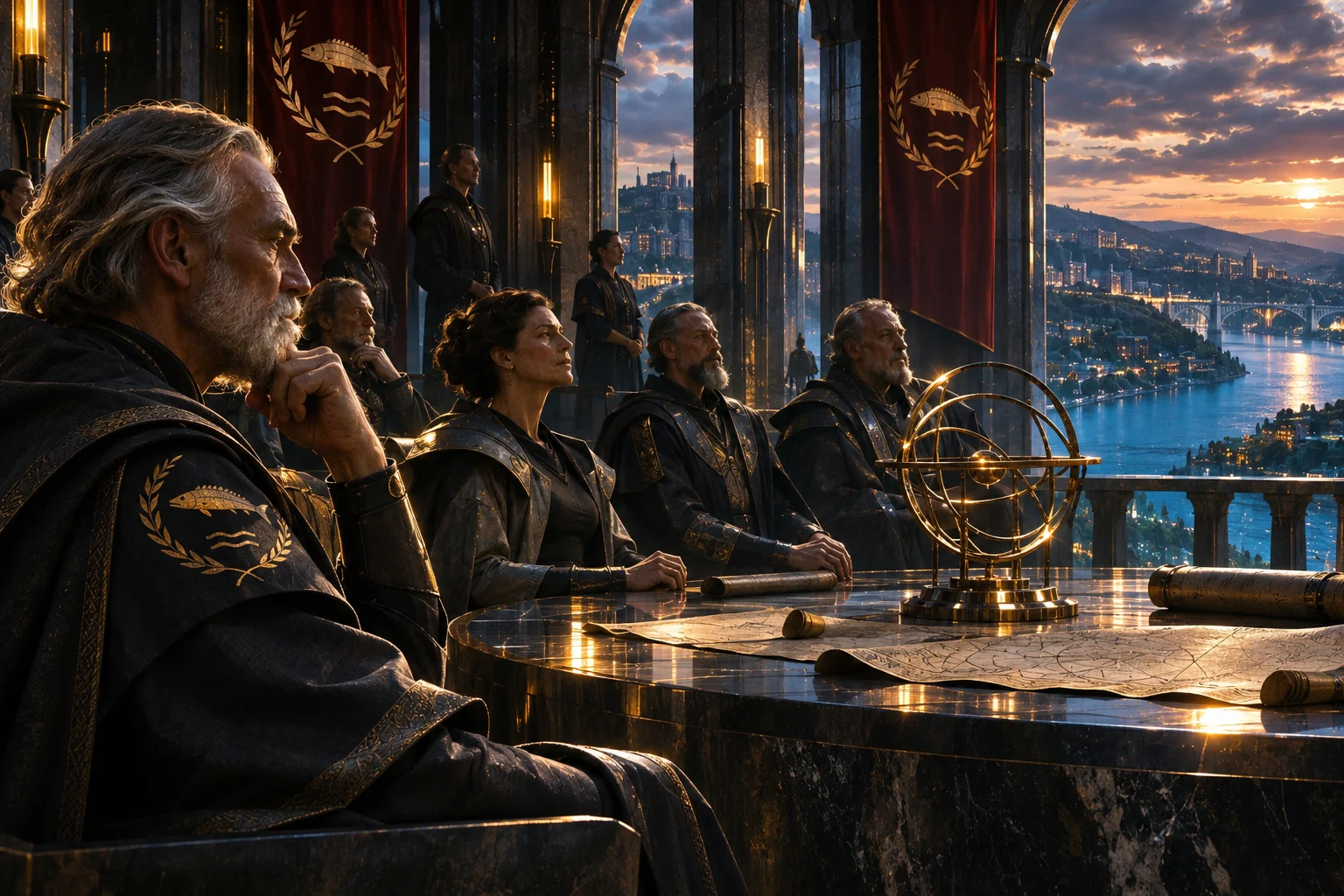
At the ninth hour, on the seventeenth day of the ninth month, in the 1914th year of the present order, the Ordo Sapientium, assembled in the Curia at Aquincum, upon the banks of the sacred Danuvius, reached its decision.
The deliberations had occupied thirty-seven days. The elders had examined the testimony of the investigators, the calculations of those appointed to verify their findings, and the objections of men whose judgment had seldom been found wanting. No question of comparable consequence had come before the Order within the memory of its living members.
The judgment, when made known, satisfied neither those who urged immediate action nor those who demanded that the undertaking be abandoned.
The course of universal time was to remain undisturbed. No attempt to alter what had already occurred was permitted. Yet the instruments by which such an alteration might be accomplished were neither to be destroyed nor neglected. Their preservation and improvement were commanded, and the necessary resources granted.
For these labours a century was allotted, though no assurance was given that a century would suffice.
The elders had considered the dangers of delay, including those which lay beyond the knowledge of men. They had considered also the dangers of acting with means imperfectly understood. Of the former they could establish neither the likelihood nor the hour; of the latter they possessed sufficient knowledge to foresee many failures and sufficient skill to prevent some.
They therefore resolved to prepare, but not yet to act.
Nor was the judgment to bind those who came after them. The authority to disturb the course of time was reserved to a future deliberation, conducted under circumstances which the living could neither know nor command.
Thus an undertaking was begun whose completion none of its authors expected to witness, and whose ultimate employment none presumed to decree.
The Sacred Game
To understand how so grave a matter came before the elders, it is necessary to speak of an institution which, to those unacquainted with the customs of that age, may appear scarcely credible.
Among a people who had devoted many generations to the cultivation of order, there existed, by deliberate provision of that same order, a fellowship whose appointed purpose was to depart from it.
This was the Ludus Sacer, the Sacred Game.
Its members, commonly called the Lusores Sacri, were drawn from every condition of society. Neither birth nor wealth conferred admission, and no man was compelled to enter. Those who did so accepted a separation from ordinary life which, once undertaken, could not simply be undone.
They were permitted liberties intolerable in those entrusted with the government of others. They might hazard their lives upon uncertain experiments, subject cherished beliefs to deliberate destruction, and pursue inquiries whose usefulness could not be demonstrated in advance. They sought to discover whether customs believed necessary were necessary indeed, and whether truths accepted by generations rested upon foundations less secure than their antiquity suggested.
But the freedom of the Game was not sovereignty.
Its members could neither command the Populus nor impose their experiments upon unwilling persons. They possessed no right to endanger the commonwealth under the pretext of inquiry. Their extraordinary liberties were purchased by the risks they accepted for themselves, not by any authority to distribute those risks among others.
They were honoured, but not obeyed.
A man might achieve great renown within the Game and yet possess no authority over the least affairs of public administration. His discoveries might be examined, adopted, or rejected by those charged with governing. His courage entitled him to admiration, but not to command.
Nor was the Game a refuge for idleness or vanity. Its freedoms demanded a seriousness proportionate to their extent. Those who sought only the appearance of daring, or mistook contempt for discipline, found little patience among their fellows.
Many of its members investigated nature. Others devoted themselves to medicine, mathematics, philosophy, exploration, or the testing of unfamiliar forms of human association. Some accomplished works of lasting benefit. Others perished in undertakings whose purposes were scarcely understood outside their own circles. The institution accepted such losses without making a virtue of failure itself.
The people followed these undertakings with curiosity, admiration, and unease. Certain experiments were conducted before public witnesses; others remained confined to places where their consequences could be contained. The exploits of the Lusores furnished instruction and entertainment alike, though neither was mistaken by the elders for proof of wisdom.
For many centuries this distinction had sufficed.
Then there arose among them an inquiry in which the distinction itself ceased to be possible.
The Discovery
The inquiry did not begin with any intention of altering the past.
Its earliest investigators were concerned with irregularities observed in the behaviour of physical systems under conditions they had learned to reproduce. The first measurements were dismissed as errors. Later measurements, obtained by different instruments and by men unconnected with the original experiments, resisted the same explanation.
What followed was neither a sudden revelation nor the achievement of a single mind.
One generation established that the irregularities were genuine. Another determined certain relations governing their occurrence. Others developed instruments by which the effects could be produced with increasing precision. Explanations were advanced, corrected, and sometimes abandoned.
The surviving records contain the names of many who contributed to these labours. To attribute the discovery to one would be unjust to the others, and would conceal the manner in which knowledge was obtained.
For a considerable period the investigators believed the effects concerned only the systems enclosed within their instruments. Upon this assumption the work continued under the liberties granted to the Sacred Game.
The assumption proved false.
The disturbances were not independent events confined to separate portions of nature. They arose from a relation belonging to the succession of events itself. What appeared to be a local alteration could not, in its complete operation, be separated from the history of the universe.
This conclusion was resisted, as conclusions of such magnitude ought to be. Instruments were rebuilt, calculations repeated, and alternative accounts examined. Some objections were overcome; others remained. But the evidence accumulated until the investigators could no longer maintain that the consequences of their work were limited to those who had voluntarily undertaken it.
By then the original investigators were old or dead. Those who recognized the greater implication had inherited both their instruments and their uncertainties.
It was these successors who brought the matter before the Ordo Sapientium.
They did not do so because their courage had failed. They did so because the freedom entrusted to their institution had never included the authority to determine the fate of mankind.
The elders assumed responsibility for the inquiry, retaining the knowledge and assistance of those who had pursued it. The Sacred Game was neither condemned for its discovery nor permitted to continue without restraint.
The question had passed beyond the Game.
The Nature of the Undertaking
The mechanism need be described here only so far as is necessary to understand the judgment. Its principles were difficult even for those who possessed the instruments, and the surviving explanations differ in matters which this history cannot resolve.
One distinction, however, was established beyond serious dispute.
The investigators had not discovered a means of entering another universe, nor of travelling into a separate history while leaving their own untouched.
There was one universe, and one succession of events.
The proposed operation would restore that universe to a former condition. All that had occurred after the chosen moment would cease to have occurred. The generations born, the cities raised, the knowledge acquired, and the deeds by which men had distinguished themselves would be undone together.
Only a small company, preserved by means belonging to the operation itself, might retain its existence, its instruments, and its knowledge through the reversal.
Their departure would abolish the very history from which they had come.
This distinction was neither concealed nor regarded as a failure of their science. It was the condition under which the judgment had to be made.
The investigators had established much concerning the behaviour of their instruments. They had not established that the complete undertaking could be performed safely. No trial of its full consequences was possible without committing the universe to the result.
Nor could the destination be selected by a number alone. A former moment was not a fixed place. The heavens had moved, the Earth had changed, and the lands familiar to men had not always possessed their present forms. To preserve a company through the reversal without knowing where, or under what conditions, it would arrive was to accomplish little.
These difficulties were known. Others, it was admitted, might remain undiscovered.
Nevertheless, the possibility could no longer be dismissed.
The Promise
It would be a mistake to suppose that the elders regarded the undertaking only as a danger.
For the first time, men possessed reason to believe that the limits imposed upon their species by the passage of time might not be final.
The lives of individuals would remain brief. No man could recover his youth merely because the universe had been restored to an earlier age. Those who died before the undertaking would not rise again to enjoy its fruits.
Yet mankind itself might acquire a continuity of existence for which no precedent could be found.
A company bearing the accumulated knowledge of a mature civilization into the distant past might establish works that otherwise would not arise for millions of years. It might cultivate life upon worlds where life had not yet appeared, preserve knowledge through epochs of destruction, and undertake labours whose completion exceeded the ordinary duration of civilizations.
If such an undertaking could be repeated, the horizons of human action would be altered still further.
The possibilities were immense. Their realization was not assured.
Some among the elders held that the opportunity was too great to neglect. They did not deny the hazards, but argued that a civilization which had learned to preserve itself through prudence ought not, for that reason, to renounce every undertaking beyond the reach of its former experience.
Others agreed that the possibility deserved preparation, yet doubted whether its promise could justify an irrevocable act while so much remained uncertain.
Neither position was treated as evidence of cowardice or folly.
The elders had not been chosen because they agreed upon every matter. They had been admitted to their Order because, over many years, their judgments had proved unusually worthy of trust, and because they had demonstrated the ability to correct themselves when evidence required it.
On this occasion their differences were not concealed.
The Danger Beyond Knowledge
There was another consideration, less susceptible to examination than the difficulties of the instruments, but not therefore without weight.
Nothing established that mankind alone could discover the means of reversing universal time.
Whether other civilizations existed, whether any had acquired comparable knowledge, or whether the universe had already undergone such an alteration, no man could say.
The absence of evidence was not proof that such beings existed. Neither was it proof that they did not.
If another civilization possessed the means and employed them, the whole history of mankind might be extinguished without warning. No army could oppose an event by which the conditions of its own existence were removed. No messenger could announce the destruction afterward.
Nor could the records of a history so abolished be consulted by those who had ceased to exist.
Some therefore argued that delay was itself a hazard. To wait for certainty where certainty could never be obtained might be to surrender the only opportunity mankind would possess.
Others answered that the possibility of an unknown rival could not justify an undertaking whose dangers were already evident. Men might destroy what they sought to preserve by acting against an enemy whose existence they had only imagined.
Both arguments carried force.
A mistaken fear might consume the labour of generations; a mistaken confidence might leave no generation to discover its mistake.
The elders were required to judge not between safety and danger, but between dangers of different kinds, whose measures were unequally known.
It was in these circumstances that they reached the judgment recorded at the beginning of this account.
The Burden of Preparation
The decree did not remain confined to the Curia.
Its execution required the labour of many who had never examined the instruments and could not reasonably be expected to understand the science upon which they depended.
Resources were assigned, institutions enlarged, and long undertakings commenced. Places were established for the preservation of knowledge, the examination of instruments, and the training of those who would inherit the work.
The Populus bore much of the cost.
Some regarded the undertaking with pride. Others questioned the wisdom of devoting so great a portion of the commonwealth’s strength to a purpose whose completion remained uncertain and whose employment had not been authorized.
Their objections were neither unexpected nor without foundation. The decree demanded present sacrifices for a possible future benefit, and those who made the sacrifices were not the same persons who might receive it.
The Curatores attended to consequences which the investigators could neither measure nor remedy by their instruments. Among the people, the prospect of a world restored to an ancient condition awakened hope in some and profound disquiet in others. Many struggled less with the danger of failure than with the thought that everything familiar might one day be willingly undone.
There were those who asked whether their children would possess a future, and others who asked whether the past could still be called past if men intended to enter it.
Such questions were not resolved by repeating the calculations.
The Curatores offered no promise that the undertaking would succeed, nor that the elders had discovered a course free from suffering. Their office was to care for those upon whom uncertainty had fallen, and to preserve the ordinary bonds of life while the commonwealth contemplated extraordinary things.
The Lusores Sacri, meanwhile, returned to their labours under a changed authority.
The discovery had not diminished their importance. It had altered the conditions under which their courage could be employed. Their experiments were now subject to restrictions whose necessity they themselves had helped to establish.
Some accepted the change readily. Others found it difficult to surrender freedoms that had long defined their order. Yet the work continued, and among its most devoted servants were men who understood that they would not live to see its completion.
The elders themselves were under no illusion concerning their place in the undertaking.
They had authorized preparation, not departure. They had determined that the instruments should be preserved and improved, but had reserved the final judgment to successors who might possess knowledge unavailable to the living.
The century named in the decree was therefore not a promise of completion. It was an obligation to labour, to preserve what had been learned, and to leave the question open.
The records of that year contain many predictions concerning what would follow. Some were confident, others fearful, and many were contradicted by events. Their authors could not have known which of their expectations would endure.
What they had done was more limited, and perhaps for that reason more remarkable.
They had encountered a possibility beyond the experience of mankind, recognized that its consequences exceeded the authority of those who discovered it, and committed their descendants to the work of understanding it without commanding them to employ it.
It was not the least remarkable feature of that age that so many should labour toward an end which they might never witness, whose accomplishment remained uncertain, and whose final authorization had yet to be given.