ACT II
I. The Death of the Elders
Of the elders who assembled at Aquincum in the 1914th year of the Present Order, the last died before the appointed century had run its course.
His death was recorded without extraordinary ceremony. He had held no office in his final years, and those who succeeded him had long possessed the authority which he once exercised. Yet among the instruments preserved in the archives was a copy of the judgment bearing his mark, together with those of men who had preceded him into death.
Thus the decree outlived its authors.
It had been their intention that it should do so. Whether they had foreseen the difficulties which followed is less certain.
For an undertaking may be inherited without its purpose being understood, and a command obeyed long after the reasons for its making have been forgotten.
The institutions of that age were not ignorant of this danger. They had been established, in no small part, to prevent the living from becoming servants of the dead.
The judgment therefore remained subject to examination. Its provisions were preserved, its assumptions challenged, and its instruments improved. No generation was required to regard the wisdom of its predecessors as sufficient proof of its own.
Nevertheless, the work continued.
The elders had forbidden interference with the timeline of the universe for a period of not less than one hundred years.
They had not forbidden inquiry.
On the contrary, they had required that the interval be devoted to the examination of every question whose answer might bear upon the undertaking.
No expedition had been authorized. No destination had been chosen. No population had been appointed to make the crossing.
The investigators inherited a prohibition and an obligation.
They were not to act.
They were to prepare.
And it was during these labours, undertaken for a journey which no living man had yet been permitted to make, that the investigators turned their attention to a creature whose ancestors had inhabited the waters of the Earth long before the first cities of men.
II. The Witnesses Beneath the Waters
The discovery that living creatures preserved within themselves recoverable testimony of ancestral experience had preceded the judgment at Aquincum.
Its full significance, however, had scarcely been understood.
The investigators had established that certain impressions received by living creatures were transmitted through successive generations, and that these impressions might, under suitable conditions, be recovered in forms resembling sight and sound.
The testimony was not complete.
It was not a continuous account of every moment experienced by every ancestor, nor did it preserve every event with equal fidelity.
The passage of generations, the alteration of inherited structures, and the limits of the instruments employed in recovery had introduced losses which no calculation could entirely restore.
Yet where the testimony remained intact, its precision was extraordinary.
The investigators could distinguish movements occurring within the smallest divisions of a second. They could observe the passage of creatures through ancient waters, the changing character of their surroundings, and the appearances of lands whose present forms bore little resemblance to those of the distant past.
Among the creatures examined, the sturgeon proved of exceptional importance.
Its lineage had endured through immense intervals of geological time, and the continuity of its inherited testimony exceeded that found among the other sufficiently complex creatures then available for examination.
The investigators did not suppose that every sturgeon preserved the same history.
Each individual carried a particular inheritance. Its ancestors had travelled through particular waters, encountered particular conditions, and survived events which others had not witnessed.
The testimony of one could therefore supplement or contradict that of another.
This made the preservation of diversity among the living specimens a matter of considerable importance.
Sturgeon were collected from distant waters, identified, examined, and returned wherever possible to the conditions from which they had been taken.
The process by which their ancestral testimony was recovered became known among the investigators as washing.
The name was older than the instruments eventually employed, and continued in use after the operation had become almost entirely unlike the procedures from which it originated.
A washing did not ordinarily destroy the testimony it recovered.
The creature remained alive, and the inherited record remained within it.
As the instruments improved, specimens previously examined were washed again, and testimony which had escaped earlier investigations was recovered.
The breeding of sturgeon was consequently undertaken upon a scale which earlier generations would have found difficult to comprehend.
Lineages were preserved not merely for their continued existence, but for the testimony which their descendants might carry.
The value of the creatures could no longer be measured by their flesh or their roe.
They had become witnesses.
And because the earliest ages of the Earth had left few other witnesses capable of furnishing such testimony, their preservation acquired a character approaching sanctity.
The investigators nevertheless distinguished between the recovery of an ancestral impression and the establishment of its place within the history of the Earth.
The testimony of the creatures supplied appearances, sounds, movements, and sequences. Through the methods developed during the investigations, these records could be assigned to their precise moments in the universal chronology, with a resolution extending to one thousandth part of a second.
This achievement had required the comparison of innumerable separate testimonies.
Records from different lineages were examined against one another. Changes in the heavens, the arrangement of coastlines, the forms of plants and animals, and the succession of geological events furnished evidence by which the recovered impressions could be placed within a common chronology.
Where the evidence was insufficient, an identification remained provisional. Where independent testimony established agreement, the investigators assigned the event its place in time.
Thus the ancestral memories of the sturgeon became more than a collection of ancient impressions.
They became a record through which particular moments in the history of the Earth could be examined, compared, and, where sufficient testimony survived, reconstructed with extraordinary precision.
The investigators could determine not merely what an ancient landscape had looked like, but when it had possessed that appearance.
They could compare the same region across immense intervals, observing the alteration of its climate, the passage of its seasons, and the succession of living creatures which inhabited it.
This knowledge was indispensable to the undertaking.
For the mechanism of reversal required not only a destination in space, but an exact moment in time. An error in either might deliver the preserved chambers into conditions wholly different from those for which they had been prepared.
By the conclusion of the appointed century, the investigators possessed a chronology of the ancient Earth whose precision would have been inconceivable to the generations which first discovered the inherited testimony of living creatures.
They were no longer confined to conjecture concerning the world into which mankind might be sent.
They could identify the place.
They could identify the moment.
And they possessed the testimony by which both might be judged.
III. The Labours Beneath the Mountains
The examination of these records required instruments of extraordinary extent.
Beneath the mountains the commonwealth established chambers containing machines whose operations consumed resources greater than those formerly allotted to entire provinces.
Their construction continued through successive generations.
The instruments were altered as new methods became available, and the calculations performed within them were repeatedly examined against independent evidence.
No single investigator possessed a complete understanding of every process by which the results were obtained.
Some devoted their lives to the recovery of a particular class of ancestral impressions.
Others examined the means by which separate testimonies might be compared.
Still others studied the ancient atmosphere, the succession of climates, the movement of continents, or the conditions under which the preservation of a bounded region might remain stable during the reversal.
There were investigators who spent decades establishing that a promising method could not succeed.
Their findings were preserved with the same care as those which produced immediate advances.
For the elders had suspended the ordinary expectation that every undertaking should justify itself through a return proportionate to the resources consumed.
They had not suspended the requirement of seriousness.
An investigation which could establish nothing, whether through success or failure, was not thereby made worthy of support.
But where a question bore upon the crossing, and where its examination was capable of producing knowledge, the expenditure of resources was not regarded as sufficient reason for abandoning it.
The investigators were required to distinguish between ignorance which could be diminished and uncertainty which could only be acknowledged.
This distinction governed much of their work.
The elders had not commanded their descendants to succeed.
They had commanded them to leave no serious question unexamined.
IV. The Places of Arrival
As the testimony of the ancient Earth accumulated, the investigators began to distinguish between ages which mankind might enter and places where mankind might endure.
The two were not necessarily the same.
There were periods in which the atmosphere appeared suitable, yet the conditions of the land presented dangers which the investigators could not sufficiently measure.
There were regions of abundant vegetation whose climates were subject to violent changes.
Elsewhere the land was stable, but the available evidence concerning water, food, or the surrounding forms of life remained inadequate.
The investigators did not seek a world without danger.
They sought a place where the first dangers might be understood well enough that the inhabitants could survive them.
The distinction was important, for the population appointed to make the crossing would possess neither the full instruments of the commonwealth nor the protection of its institutions.
Its first obligation would be to remain alive.
Only thereafter could it undertake the restoration of the knowledge and material capacities upon which a more secure existence might depend.
By the conclusion of the appointed century, several destinations had been judged suitable for further consideration.
They lay in different ages, separated in some cases by millions of years.
For each the investigators assembled evidence concerning the composition of the atmosphere, the prevailing temperatures, the passage of the seasons, the character of the surrounding terrain, the availability of water, and the stability of the ground beneath the proposed place of arrival.
Among the periods examined were ages belonging to the early Cretaceous, when the Earth bore forests, rivers, and living creatures unlike those familiar to the inhabitants of the Present Order.
No final destination was appointed.
That authority had been reserved to the elders.
The investigators therefore preserved the evidence for several possibilities, together with the reasons for preferring or rejecting each.
The investigators had learned enough to establish that the undertaking need not depend upon a single uncertain place. Each proposed destination was defined by its geographical position and its exact moment in the universal chronology, supported by recovered testimony of the conditions prevailing there.
The uncertainty which remained concerned not when or where mankind would arrive, but whether the evidence was sufficient to ensure that it could survive.
V. The Great Cavern
The place prepared for the crossing lay deep beneath the earth, within ancient deposits of salt.
The choice had not been made for the convenience of its inhabitants.
It followed from the conditions imposed by the mechanism of reversal.
The investigators had established that the preservation of a region depended upon its boundaries, its contents, and the stability of the conditions maintained within it.
The entire surrounding earth could not be carried through the reversal.
Nor was it necessary that it should be.
The undertaking required the preservation of particular chambers and passages, together with the people, instruments, breathable air, structural supports, and stores contained within them.
Beyond the appointed boundaries, the material conditions of the ancient Earth would be restored.
The investigators therefore excavated chambers of immense dimensions, connected by passages whose forms were calculated with exceptional precision.
Within them were constructed dwellings, places of assembly, stores, and the instruments necessary for sustaining life.
Other chambers contained machines intended for purposes which the inhabitants would not immediately understand.
The engineers marked the limits of preservation with beams of light.
These boundaries distinguished the spaces which would endure from those which would be surrendered to the returning earth.
A passage which extended beyond the appointed limit would not remain an empty passage after the reversal.
The ancient rock would occupy its place.
For this reason the structures adjoining the boundaries were subjected to repeated examination.
The preservation of a chamber was of little value if the conditions established at its walls rendered it uninhabitable.
Within the protected region were also placed stores of materials whose acquisition would otherwise require industries not yet available to the new population.
Metals, minerals, instruments, and records were gathered according to calculations extending far beyond the immediate necessities of survival.
Among the largest instruments preserved was a machine composed of successive articulated sections, constructed to advance through the surrounding rock.
Its purpose was to establish a passage from the preserved chambers to the surface of the ancient Earth.
For the inhabitants would not awaken beneath an open sky.
The world beyond their cavern would have returned to an age in which its present passages had never been excavated.
The way outward would have to be made anew.
The engineers also prepared a succession of provisions intended to support the first century after arrival.
These concerned the maintenance of air and water, the production of food, the acquisition of energy, the recovery of useful materials, the treatment of sickness, the education of succeeding generations, and the establishment of institutions capable of governing a growing population.
The plans were not regarded as commands which future generations must obey without alteration.
They were instruments of preparation.
For the investigators could not know which of their expectations would prove mistaken, nor which unforeseen circumstances would require the inhabitants to depart from the arrangements made for them.
The first century of inquiry had therefore produced a plan for the first century of settlement.
And within the cavern were preserved machines containing the accumulated knowledge of the Present Order.
These were not intended to be available in their entirety from the beginning.
The power required for their operation would have to be established through the labours of those who came afterward.
Until then, the greater part of the inheritance would remain silent.
Thus the investigators prepared a place in which mankind might begin again beneath the earth, surrounded by the instruments of a civilization whose existence its inhabitants would not remember.
It was remarked in the records that the earliest ancestors of mankind had also sought shelter in caves, and had left upon their walls the signs of lives whose meanings their distant descendants could only imperfectly recover.
The comparison was not employed as an argument for the undertaking.
It was preserved among the observations made concerning it.
VI. The Peoples of the Sacred Game
The preparation of the cavern did not resolve the question of those who were to inhabit it.
The investigators had long understood that the preservation of human life could not be reduced to the provision of food, shelter, and instruments.
A population might possess every material advantage available to it and nevertheless fail to establish a durable society.
It might exhaust its resources, abandon the obligations necessary for cooperation, or prove incapable of adapting to conditions which its founders had not anticipated.
The Sacred Game was therefore entrusted with investigations concerning the character and constitution of the people appointed for the crossing.
The institution possessed considerable experience in the creation and observation of constructed societies.
Whole populations had been raised beneath laws and customs devised for the purpose of inquiry.
Some were given elaborate institutions from their beginning.
Others were permitted to establish their own.
There were societies in which individual liberty was cultivated above every competing obligation, and others in which the preservation of the community governed almost every aspect of life.
Some were founded upon the authority of elders, others upon contests of strength, intelligence, or reputation.
Their religions, customs, and forms of government differed according to the questions which the investigators sought to examine.
These undertakings were known to the Populus as Games.
Their progress was observed with great interest.
The inhabitants of the commonwealth followed the fortunes of particular players, remembered their achievements, and preserved accounts of undertakings which had concluded centuries before.
Yet the honour which attended the Sacred Game in that age had not belonged to it from its beginning.
In its earliest years the institution had possessed neither the reverence of the Populus nor a sufficient number of persons willing to enter its dangers.
Its participants had therefore been obtained by selection.
Those appointed were separated from their households and declared dead to the lives which they had formerly possessed.
Their families were permitted to refuse the judgment and withhold the customary rites of mourning.
But neither refusal nor mourning altered the appointment.
Those who had passed into the Game could not return.
Only through successive generations did the institution acquire the character by which it was afterward known.
Its undertakings produced knowledge. Its participants demonstrated courage. Their names were preserved, their deeds recounted, and the dangers which had once required compulsion came to be sought voluntarily.
The older manner of selection gradually fell into disuse.
It was not abolished.
By the time of the investigations concerning the crossing, the players were honoured throughout the commonwealth.
They possessed no authority to command the elders, and their sanctity did not exempt them from the obligations of the institution they had entered.
They were honoured, but not obeyed.
They were loved, but not spared.
For the conclusion of a Game remained governed by ordinances which had endured through the changes in its reputation.
When the purpose appointed to an undertaking had been exhausted, or the resources allotted to it had been consumed, the judgment of Consumptio Virium was pronounced.
Thereafter followed Consumptio Ludi, the formal conclusion of the Game.
Its participants were granted the appointed interval in which to order their affairs.
At the conclusion of that interval, their lives were brought to an end according to the ordinances of the institution.
The constructed world was then surrendered to fire.
Its dwellings, instruments, works of art, and material possessions were destroyed.
No object was preserved merely because it had been cherished by those who made it.
Thereafter came Memoria Ludi.
The names of the participants were entered into the records, together with the findings of the undertaking, its achievements, its failures, and those matters which had been discovered without having been sought.
The investigators distinguished carefully between the destruction of a Game and the destruction of its knowledge.
The former was required.
The latter was forbidden.
Many of the constructed populations had not entered their undertakings by choice.
Their inhabitants had been born within worlds prepared for them, and had lived according to circumstances which they neither understood nor possessed the means to alter.
This distinction was known to the investigators.
It was not omitted from their records.
The evidence concerning the crossing was therefore obtained through undertakings whose conclusions had cost the lives of entire populations.
Some had succeeded according to their appointed purposes.
Others had failed.
All had been concluded and burned.
And their findings were gathered for presentation to the elders.
VII. The Northern Peoples
During the latter years of these investigations, the northern frontier of the commonwealth remained unsettled.
Beyond its established territories dwelt peoples whose institutions and customs differed greatly from those of the Present Order.
They possessed neither its instruments nor its abundance, and their manner of life was governed by necessities from which the inhabitants of the great cities had long been relieved.
The frontier had been contested for many years.
In the accounts of the commonwealth these peoples were frequently called barbarians, though the term described their distance from its customs more accurately than any deficiency of understanding.
They were formidable in war.
Their warriors possessed a courage which even their enemies acknowledged, and a cunning which repeatedly frustrated the commanders sent against them.
They fought with a determination which made their capture difficult, for many preferred death to surrender.
Their men and women were also remarked upon for their beauty, a quality which the chroniclers of the frontier recorded with a frequency scarcely less remarkable than their accounts of violence.
It was from among these peoples that the Sacred Game obtained many of the captives employed in undertakings which required persons outside the ordinary protections of the commonwealth.
The investigators soon observed differences of considerable importance.
The inhabitants of the Present Order had been cultivated through many generations for intelligence, cooperation, and the maintenance of a society whose institutions had rendered life secure.
They were capable soldiers, obedient to discipline and exceptionally proficient in the employment of their instruments.
Yet they did not commonly display the same tenacity in the preservation of their own lives which the investigators encountered among the northern captives.
The latter possessed fewer advantages, but showed an extraordinary capacity to endure privation, adapt their conduct to danger, and pursue survival with little regard for conventions which the commonwealth considered indispensable.
Their courage was not always accompanied by obedience, nor their ingenuity by restraint.
These qualities complicated the investigations, but also rendered them valuable.
The Sacred Game had long sought a population capable of establishing itself in the ancient Earth without the protection of an existing civilization.
In the northern peoples the investigators believed they had discovered dispositions which their own society had gradually ceased to cultivate.
The conclusion did not follow immediately.
Many undertakings were examined, and the records distinguished between qualities acquired through upbringing and those believed to endure through descent.
The investigators also recognized that the conditions of captivity could alter the conduct of those subjected to them.
Nevertheless, the evidence accumulated over successive generations was judged sufficient to support a recommendation of exceptional consequence.
The greater part of the people appointed for the crossing should descend from the northern tribes.
Their customs would not be preserved.
Their language would not be inherited.
Their descendants would be raised within a society constructed for the undertaking, and the testimony of their actual ancestry would be severed at birth.
Thus the investigators proposed to preserve the qualities which they valued while extinguishing the historical inheritance of those who possessed them.
The northern peoples had fought the commonwealth upon its frontier.
Their descendants were now proposed as the founders of a civilization which the commonwealth itself would never see.
VIII. The Selection of the First-Born
The recommendation concerning the northern lineages was accepted as the basis for further preparation, though not without qualification.
The investigators determined that more than half of the population should descend from the peoples beyond the northern frontier.
Yet they declined to make these peoples the sole ancestors of the new civilization.
One quarter was to be drawn by lot from among the newborn children of the Populus.
No distinction of wealth, reputation, accomplishment, or family standing was to govern the drawing.
The children of the obscure stood beside those of the celebrated, and neither the virtues nor the failings of their parents altered their chances.
When the lot fell upon a household, its parents were informed that their newborn child had been appointed to the undertaking.
They were instructed to mourn its passing.
The child was not dead, nor was its survival concealed from them.
But it would never return to their household, would never know their names, and would never inherit the memory of their lives.
The customary rites for the dead were therefore performed.
Some parents refused the rites, maintaining that no death had occurred and that no ceremony could make their living child a departed one.
The institutions of the commonwealth did not contest their right to hold this conviction.
Neither did they return the children.
For the old provisions of the Sacred Game remained in force.
The law permitted the parents to reject the judgment.
It did not permit them to recover the dead.
The remaining places within the population were reserved for lineages of a different character.
Among these were persons distinguished by qualities which the investigators considered exceptional, whether in body, disposition, or faculties of mind.
Some possessed capacities seldom encountered among ordinary men.
Others exhibited peculiarities whose usefulness remained uncertain, but whose exclusion the investigators judged premature.
A small number were to descend from the players of the Sacred Game, their children having been taken at birth before the conclusion of their parents’ undertakings.
A still smaller number were to be drawn from the families of the Sapientes Probati.
The elders did not reserve a privileged place for their own descendants, nor were those descendants to possess any special standing within the population to be created.
Their inclusion was limited.
The investigators had sought neither an average of the existing peoples nor the reproduction of any one among them.
They intended to preserve a breadth of human inheritance sufficient to meet circumstances which no calculation could wholly anticipate.
The northern peoples were to contribute the greater part, for the qualities observed among them were judged indispensable.
The Populus would contribute by lot.
The remaining lineages would preserve possibilities whose significance might become apparent only after many generations.
None of these distinctions would be known among the people themselves.
In the records prepared for the elders they were designated Primigenii, the first-born, for with them the inheritance of ancestral memory was to begin anew.
Among the Populus another name prevailed.
They were called Redituri, those who would return.
The name was not altogether accurate.
They would travel into the Earth’s past, but no road had been prepared by which they might return to those who sent them.
Nor would they know that they had departed.
Of these two names, neither was ever spoken among the people to whom they referred.
IX. The Cave of Time
Of the many undertakings conducted by the Sacred Game, few were known in their entirety to those who witnessed them.
Some endured for generations.
Others were concluded within the lifetime of their founders.
There were Games in which whole peoples were raised beneath laws and customs devised for the purpose, and others in which the inhabitants were permitted to discover their own institutions, subject only to conditions established before their birth.
To the Populus these undertakings were familiar.
It was therefore not remarkable that another population should be assembled, another history composed, and another people instructed in a language, religion, and manner of life which had never existed beyond the boundaries of its appointed world.
Nor was it remarkable that the undertaking should require a place of considerable extent.
The Sacred Game had constructed cities, cultivated forests, diverted rivers, and enclosed entire territories for purposes whose significance became apparent only when their investigations were concluded.
Yet the place prepared for this undertaking differed from those which had preceded it.
It lay within the great cavern selected for the crossing.
There a people would be born, grow to maturity, establish households, bury their dead, and pass their customs to succeeding generations.
They would know the place as their ancestral home.
They would be instructed in the Latin tongue, and in the worship of gods whose names had been known long before the establishment of the Present Order.
Their sacred writings would preserve an account of their beginnings, and from that account they would derive the name by which they knew themselves.
Temporis Antrigenae.
Those born of the Cave of Time.
Among themselves they were commonly called Antrigenae.
The name was not without truth.
But the truth which it contained was of a kind that none among them possessed the means to understand.
For the cavern was not merely the place in which their society had been established.
It was the boundary of the world appointed to survive the reversal.
The inhabitants knew their chambers, their passages, their dwellings, and the limits imposed upon their movements.
They understood these things according to the history and ordinances given to them.
They did not know that their world had been constructed for departure.
Nor did they know that the earth beyond its walls would one day be exchanged for another.
Among the instruments preserved within the appointed chambers were machines of immense power, together with stores of materials and records sufficient, it was hoped, to assist the establishment of a new civilization.
The greater part of this inheritance was to remain inaccessible.
The people for whom it had been prepared would not possess the knowledge required to employ it, nor would the instruments reveal their purposes until the conditions appointed for their use had been fulfilled.
Thus the investigators prepared two inheritances.
The first was living: the people themselves, their bodies, customs, language, and the dispositions cultivated through generations of experiment.
The second was silent: the knowledge of the civilization which had created them, preserved in machines whose contents their descendants might one day recover.
Between these inheritances the investigators established no immediate passage.
The Antrigenae were not intended to awaken as servants of the Present Order, nor to undertake its unfinished obligations.
They were intended to live.
And in this the undertaking differed from every Game which had preceded it.
For the ordinary conclusion of a Game was the extinguishing of the world created within it.
Its knowledge was preserved, its participants numbered among the departed, and its material remains surrendered to the concluding fire.
Here the purpose was otherwise.
The investigators had prepared a world whose inhabitants were to survive the ending of the undertaking, though they would never know that an ending had occurred.
The Game would conclude.
Its people would continue.
X. The Gods Before the Order
Of the religion appointed to the Antrigenae, the investigators made a choice which surprised even those familiar with the liberties permitted to the Sacred Game.
They did not devise new divinities.
Instead, they turned to the oldest surviving records of the commonwealth, to the centuries preceding the establishment of the Present Order, when the ancestors of its inhabitants had worshipped powers whose names had long since ceased to govern the affairs of men.
From these ancient traditions they restored a multitude of gods.
There were gods of order and beauty, and others whose province was vengeance and the fury of battle.
There were powers of thunder and storm, of pleasure and desire, of childbirth and the protection of infants, of harvest, sickness, old age, and death.
No single divinity encompassed the whole of existence.
The gods possessed different natures, and their purposes were not always in agreement.
What one favoured another might oppose.
Their favour was sought through prayer, offering, courage, and observance, but no worshipper was assured that devotion would preserve him from suffering.
Among these powers one stood foremost.
He was represented as an aged wanderer, possessing but a single eye, who passed among gods and men in search of knowledge.
His names in the surviving traditions were Wotan and Odin.
He was invoked in matters of wisdom and war, of sacrifice, poetry, and the uncertain fortunes of men.
The investigators did not require the elders to affirm the existence of these divinities.
Their concern was with the people who would worship them.
For the religion was intended to accompany the Antrigenae into a world where the protection of the commonwealth would be absent, where suffering could not always be prevented, and where the preservation of life would demand qualities which centuries of security had rendered uncommon.
The ancient gods had not promised mankind a world without hardship.
They had offered instead a language in which hardship, courage, pleasure, birth, death, and the pursuit of wisdom might each possess a sacred place.
The investigators did not expect the gods to be understood alike by all who worshipped them.
Among the Antrigenae, the greater number were expected to regard the divine powers as living beings, whose favour might be obtained and whose displeasure might be incurred.
They would offer prayers in the belief that these were heard, and seek signs of divine intention in the fortunes of their households, their harvests, and their wars.
Others would regard the same powers differently.
To these, Wotan might signify the pursuit of wisdom and the terrible price of knowledge, while the gods of thunder, fertility, and death expressed those powers of existence before which mankind had always stood.
Such persons were not thereby excluded from the observances of their people.
The investigators had found that religious conviction did not arise with equal force or in identical form among all dispositions.
Certain family lines appeared more inclined toward devotion, others toward doubt, and still others toward forms of belief which combined reverence with inquiry.
They did not regard this diversity as a defect requiring correction.
A people composed entirely of unquestioning believers might preserve its customs with remarkable fidelity, yet prove slow to recognize circumstances for which those customs offered no remedy.
A people composed entirely of doubters might discover much, yet fail to sustain the common obligations upon which its survival depended.
The investigators therefore sought neither universal belief nor universal disbelief.
They sought a people among whom the gods would be honoured, but whose minds would not all be governed in the same manner.
For they could not know which disposition the ancient Earth would favour.
XI. The Book of the Ancestors
The restoration of the ancient gods was not accomplished by the recovery of their names alone.
The investigators had obtained from the archives many accounts of their worship, composed in ages when the ancestors of the commonwealth had still lived beneath kings, fought over narrow territories, and attributed the fortunes of men to powers whose intentions could neither be commanded nor fully understood.
These accounts were not in agreement.
The gods bore different names among different peoples.
Their deeds were variously remembered, their kinships disputed, and the observances considered sacred in one land were sometimes unknown in another.
The investigators did not regard these differences as grounds for rejecting the traditions.
They had not undertaken to establish which accounts were true.
Their purpose was to furnish the Antrigenae with a religion capable of accompanying them through the whole course of human existence, from birth and the pleasures of youth to the labours of maturity, the terrors of war, and the final obligations owed to the dead.
From the surviving traditions they therefore composed a sacred inheritance.
Its principal writings were preserved in Latin, the language appointed to the new people.
They contained accounts of the gods, the deeds of ancient men, the obligations of households, and the rites by which the living honoured those who had preceded them.
The investigators did not attempt to remove every contradiction from these writings.
They considered some of them among the most valuable features of the ancient traditions.
For the people appointed to inhabit the ancient Earth would encounter circumstances in which courage opposed prudence, mercy opposed necessity, and the preservation of one life required the abandonment of another.
A religion which promised that every virtue could be satisfied at once was judged unsuitable for such a people.
The sacred writings governed not only the relations of men with the gods, but also those between generations.
The dead were to be remembered.
The names of ancestors were to be honoured.
A household was understood to possess obligations extending beyond the lives of those who presently inhabited it.
In this manner the investigators established among the Antrigenae a reverence for continuity.
Yet there was a matter concerning which the writings remained silent.
The ancestors whose memory the people honoured were not the ancestors from whom their bodies had descended.
Their true forebears had dwelt in the cities of the Present Order, upon its northern frontier, and within the institutions of the Sacred Game.
Their children had been taken from them, some by conquest, others by lot, and still others through arrangements whose records were preserved only in the archives of the undertaking.
Of these things the Antrigenae knew nothing.
At the birth of each child, the custodians performed the hidden rite by which the inherited testimony of earlier generations was severed.
The rite was called Renatio.
The people themselves possessed an observance involving water and the beginning of life.
Its meaning was established in their sacred writings, and its performance belonged to the customary duties of the household.
They did not know that another act, concealed from them, accompanied the beginning of their children’s lives.
The severance did not destroy the child’s faculties, nor did it prevent the formation of new memories.
It removed the inherited testimony of the generations which had preceded it.
The descendants of those subjected to the rite would inherit no recoverable account of the lives which had existed before that severance.
The investigators had employed washing to recover the testimony of ancient creatures.
Here they employed their knowledge to make such recovery impossible.
Thus the Antrigenae were instructed to remember their ancestors, while the means by which their actual ancestry might have been recovered were deliberately destroyed.
The investigators had not overlooked this contradiction.
They had judged that the preservation of the new people’s independence required it.
For the Antrigenae were not to be bound by gratitude to those who had created them, nor by resentment against those who had taken their forebears from their homes.
They were to inherit a past sufficient to give meaning to their lives, but not one which imposed upon them the unfinished purposes of the Present Order.
Whether a people could be given a history and thereafter make it wholly their own was a question upon which the investigators had accumulated much evidence, though none which could settle the matter beyond doubt.
The undertaking was nevertheless prepared upon that assumption.
And so the Antrigenae honoured gods whose names were older than the commonwealth, spoke a language recovered from its distant past, and remembered ancestors who had never lived.
They possessed a sacred history.
They did not possess their own.
XII. The Return to Aquincum
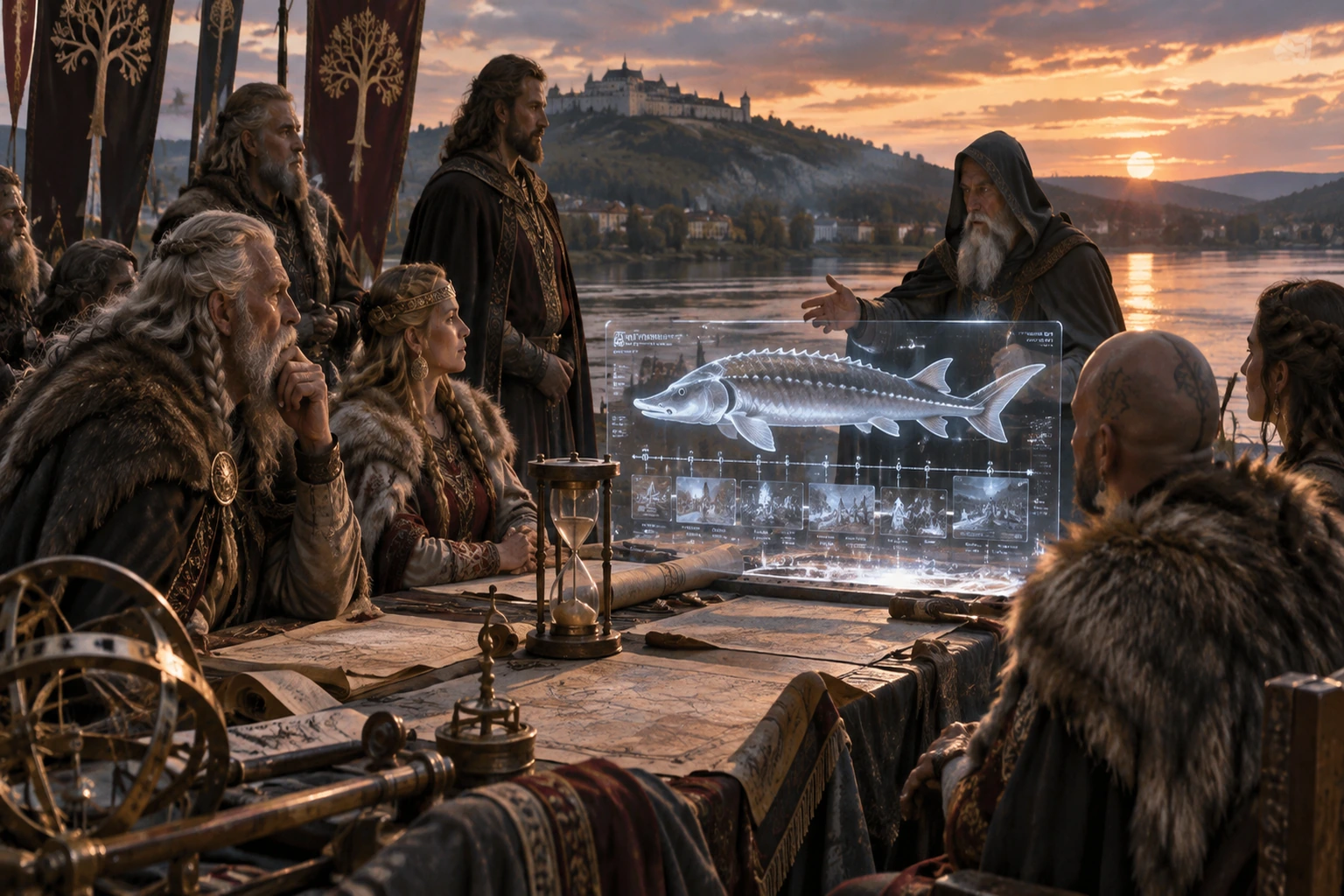
In the summer of the 2026th year of the Present Order, the Ordo Sapientium assembled once more at Aquincum, upon the banks of the sacred Danuvius.
One hundred and twelve years had passed since their predecessors had gathered in that place to consider the discovery of the Sacred Game.
Of those who had pronounced the first judgment, none remained alive.
The hall was the same, and the river continued its passage beneath the walls, indifferent to the generations which had succeeded one another upon its banks.
The judgment of the 1914th year had forbidden interference with the timeline of the universe for a period of not less than one hundred years.
It had required that the intervening generations devote themselves to investigation, that no serious question be left unexamined, and that the consequences of the discovery be understood as far as the powers of the commonwealth permitted.
The appointed century had passed.
The investigators now came to present their inheritance.
First were laid before the elders the records concerning the ancient Earth.
From the recovered testimony of living creatures, and particularly from the ancestral memories of the sturgeon, the investigators had assembled accounts of ages preceding the earliest history of mankind.
These records had been compared, examined, and corrected through successive generations of inquiry.
The elders were shown the places to which the undertaking might be directed.
For each proposed destination there were records of the atmosphere, the climate, the character of the land, the abundance of water, and the dangers which could be established from the surviving evidence.
Some sites were distinguished by the mildness of their seasons.
Others by the abundance of their resources, the stability of the ground beneath them, or the conditions favourable to the establishment of habitation.
No single place was represented as free from danger.
The investigators presented their uncertainties together with their conclusions, and the grounds upon which each destination had been judged suitable.
The elders were not asked merely to believe that the ancient Earth might sustain human life.
They were shown the evidence upon which that belief rested.
Thereafter came the account of the cavern.
Its chambers had been excavated deep within the ancient deposits of salt, and its boundaries established according to the conditions required for preservation through the reversal.
The investigators demonstrated which passages, structures, instruments, and stores would endure, and which would be surrendered to the returning earth.
They presented the means by which the inhabitants would be sustained, the instruments prepared for their eventual passage to the surface, and the provisions intended to support the first generations of settlement.
There were records of failures, of calculations abandoned, of structures altered, and of dangers which had been discovered only after the destruction of earlier designs.
The elders examined these alongside the completed works.
For the undertaking had not been judged successful merely because its instruments could be constructed.
It had been required that their operation be understood, their limitations established, and their failure considered wherever consideration remained possible.
Then the investigators presented the findings concerning the people appointed to make the crossing.
Of all the labours undertaken during the intervening century, these had required the greatest number of separate Games.
Whole societies had been established and observed.
Generations had lived beneath laws and customs devised for the purpose of inquiry.
Their capacities for endurance, cooperation, conflict, invention, and recovery from calamity had been examined.
Some undertakings had yielded the results for which they were established.
Others had disclosed matters which their founders had not anticipated.
Many had failed according to their original purposes, though their failures had furnished evidence of considerable value.
All had been concluded according to the ordinances of the Sacred Game.
Their inhabitants were dead.
Their dwellings, instruments, and possessions had been surrendered to the concluding fires.
Their names and the records of their lives remained in the archives.
From these investigations the Sacred Game had derived its recommendations concerning the ancestry and upbringing of those who would inherit the ancient Earth.
The greater part were to descend from the peoples of the northern frontier, whose courage, cunning, and tenacity had been observed through many undertakings.
One quarter were to be drawn by lot from the newborn children of the Populus, without distinction of family or standing.
The remainder would preserve lineages selected for exceptional characteristics, together with small contributions from the descendants of the Sacred Game and a still smaller number from the families of the elders themselves.
The investigators presented the grounds for these proportions, the alternatives they had rejected, and the evidence upon which their conclusions depended.
They also described the constructed society within which the new people would be raised.
Its inhabitants would speak Latin.
They would honour the gods whose names had preceded the establishment of the Present Order, and foremost among them Wotan, the one-eyed wanderer.
They would know themselves as the Antrigenae, those born of the Cave of Time.
They would possess no knowledge of the commonwealth which had created them, nor of the circumstances of their selection.
Their ancestral memories would be severed at birth.
The records of their true origins would remain preserved within the instruments appointed to accompany them, inaccessible until the means of their recovery had been established.
Of these arrangements the investigators offered neither concealment nor apology.
They presented the reasons for their adoption, the consequences which could be foreseen, and those which remained uncertain.
For the elders had not assembled to celebrate the achievements of the Sacred Game.
They had assembled to judge them.
When the presentation was concluded, the records were placed at the disposal of the Ordo Sapientium.
There were accounts of the ancient Earth, of the cavern and its instruments, of the populations created and extinguished, and of the people whose lives were intended to continue beyond the ending of the commonwealth.
The investigators had fulfilled the charge laid upon their predecessors.
They had prepared a means by which mankind might enter an earlier age of the world.
They had established places where it might survive.
They had created a people whom they believed capable of doing so.
But they had not been granted authority to undertake the crossing.
That authority remained with the elders.
And so, in the same hall where their predecessors had once forbidden interference with time, the Sapientes Probati received the evidence upon which the fate of the Present Order would now be judged.
Beyond the walls the Danuvius flowed beneath the summer sun.
The river had witnessed the first judgment.
It would witness the second.