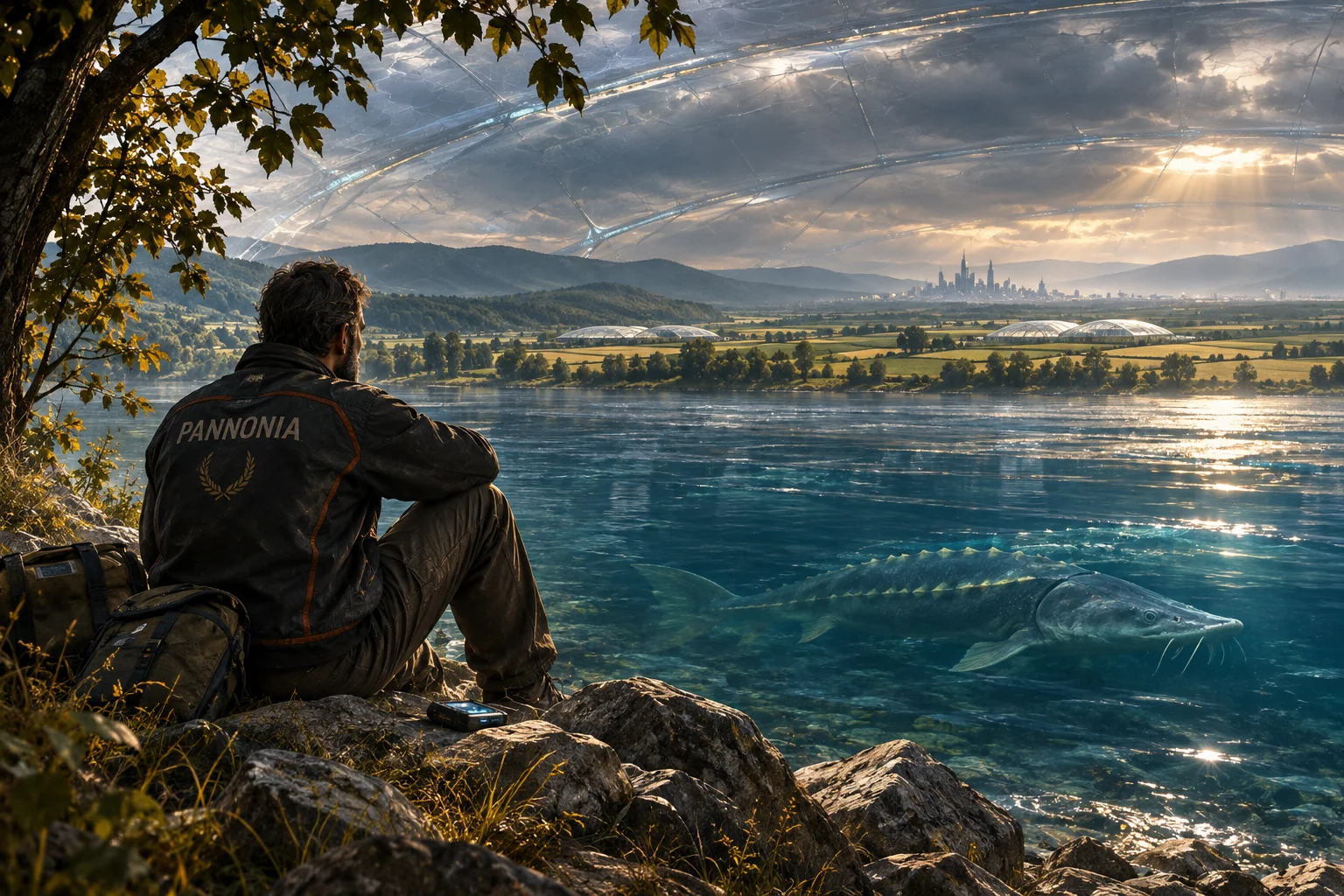
I have come into possession of a memory which, so far as I can determine, belongs neither to my own life nor to any experience I might reasonably have acquired. In it, I observed certain things with the ordinary certainty of sight, while others I knew without having learned them, a distinction which I find difficult to account for. How such a memory came to reside within me I can scarcely imagine, nor can I say whether it concerns a time already passed or one that has yet to arrive. I shall therefore relate what I remember, taking care to distinguish what I saw from what I somehow understood. For I would rather confess the limits of my knowledge than improve upon a recollection whose origin is already sufficiently strange.
The place was the Carpathian Basin. Of this I had no doubt, although much of what I saw would have been unfamiliar to anyone acquainted with that country in our own age. The mountains stood where I should have expected them, yet between their distant heights there stretched an immense transparent covering, resembling in its substance a kind of plastic, though of a perfection and extent beyond anything I have encountered. It rose many miles above the earth, enclosing the whole basin beneath a single artificial sky.
I knew, without knowing how, that the air beneath it was thicker than our own and contained a greater abundance of oxygen. I understood also that this enormous covering could regulate the sunlight passing through it, admitting certain portions of its light while withholding others. When left entirely transparent, it permitted the heavens to retain their natural blue, so that one might look upward and see nothing remarkable. Yet this apparent simplicity concealed a power over the light of the sun which I could scarcely comprehend.
The country beneath was given over in great part to cultivation. It was a land of extraordinary fertility, where vegetables grew in such abundance and of such quality that their cultivation appeared to be among the principal occupations of its inhabitants. I remember tomatoes and pumpkins, neither particularly remarkable in appearance. Yet I knew that their flavour was exceptional, and that an immense labour of science had been devoted to obtaining such perfection from things so ordinary.
Far away, through a veil of mist, I could distinguish the presence of an enormous city. I cannot describe its buildings, for I saw them too indistinctly, nor do I remember any movement that might have betrayed the activity of so great a population. There was no distant tumult, no sound of traffic, nor any display of lights to announce its existence. Indeed, the stillness of the entire country impressed me more than its size. I remember no wind.
Through this quiet land ran the Danube.
Its waters possessed a blue of such depth and brilliance that I have difficulty finding a comparison adequate to it. I have known that river in its familiar colours, grey beneath a clouded sky and greenish where the light favours it, but this was neither. The blue seemed to belong to the water itself. The river continued its ancient passage through the basin, winding like a great serpent through a country which, for all its strangeness, I recognised as the same land.
Upon a rock beside the water sat a man.
He wore a jacket of an unfamiliar kind, upon which I could plainly read the word Pannonia, written in Latin letters. I knew this to be the name of the great enterprise responsible for much of the cultivation and biological research carried on throughout the basin, and I knew also that the man was employed by it. Yet I cannot recall learning either fact, and must leave the reader to make of this certainty what he will.
It was his day of rest, or something corresponding to what we should call a weekend. He had come to the river for his own pleasure, and although I knew that he intended to fish, I saw neither rod nor hook in his possession.
For a time he sat looking across the blue water, apparently content to remain where he was.
Then, from somewhere above, there came a little melody.
It was brief and curiously agreeable, possessing something of that orderly gaiety which I associate with the music of Mozart. I cannot reproduce it, though I remember its character distinctly. It seemed to announce something, and scarcely had it ended when a deep mechanical murmur passed through the basin. The sound was neither violent nor particularly loud, yet it possessed a breadth which suggested machinery of an almost inconceivable extent.
The man raised his head.
Above him the blue of the heavens began to change. The immense covering, which until that moment had been nearly impossible to distinguish from the sky itself, altered the passage of sunlight through its substance. A luminous grey spread across the heights, until the whole basin appeared to lie beneath the roof of some prodigious house for the cultivation of plants.
The change was remarkable, and I remember that the man continued to look upward for some moments, as though the spectacle had not lost its power to astonish him despite his familiarity with it.
Then he spoke.
The words were unknown to me. Their sounds bore a distant resemblance to Hungarian, yet I could not understand a single sentence. Nevertheless, I knew that he was expressing irritation. The alteration of the sky had occurred at an unexpected hour, and he was displeased that the customary arrangement had been disturbed.
It is perhaps worth observing how readily men accommodate themselves to wonders. Here was a person living beneath an artificial heaven, capable of regulating the light of the sun across an entire country, and his immediate concern was that it had failed to observe its proper schedule. I do not mention this to ridicule him, for I suspect that our own complaints would appear equally peculiar to anyone who had never witnessed the ordinary arrangements of our lives.
His displeasure was brief. He lowered his gaze toward the river and turned his attention to the business for which he had come.
From a pocket at the front of his jacket he withdrew a small object, scarcely larger than what we should call a memory stick. Around it was wound a filament so fine that I could hardly distinguish its substance. Light travelled along this filament in little pulses, passing toward the object and returning again, even while it lay idle in his hand.
He unwound a portion of the line and examined it with care.
Next he produced a black band, which he placed around his forehead and across his eyes. Its form reminded me of a knitted cap from which the upper portion had been removed, although its material and construction were unlike anything familiar to me. Small points of light appeared upon it.
I was surprised to discover that the covering of his eyes did not deprive him of sight. He continued to perceive the riverbank and the water before him, though by means of the apparatus rather than his uncovered eyes. Indeed, his vision now extended beneath the surface of the Danube, where the outlines of several enormous fish became visible.
He connected the fine optical filament to the band and remained still for a little while.
There was something in his manner which reminded me of a man preparing to leap from a great height for pleasure. He was not afraid, so far as I could judge, but neither was he careless. He seemed to rehearse silently what he intended to do, attending to small matters of preparation which experience had taught him not to neglect.
I understood that this was a form of fishing, though no fish was to be caught, injured, or removed from the water.
The creatures beneath the surface were sturgeons, but of a size and appearance which made the name seem almost insufficient. Their bodies were immense, their skins silver, and their movements possessed the slow assurance of animals for whom the river offered little opposition. I thought of dragons, not because they resembled any fabulous beast in their anatomy, but because their antiquity and great size gave them something of the dignity which men have always attributed to such creatures.
I knew that they were the objects of extraordinary care, and that the enterprise called Pannonia regarded them as sacred.
I must explain what I understood by that word, lest it suggest a worship which I did not observe. Their sacredness lay in their capacity to disclose things otherwise inaccessible to human knowledge. They were living means of approaching a hidden order of existence, and their preservation was consequently a matter of the greatest importance.
The man, however, appeared concerned chiefly with persuading one of them to approach his little instrument.
Having completed his preparations, he cast the object out over the water.
It entered the Danube and began to descend. Yet it did not sink as an ordinary weight would have done. After travelling a certain distance it stopped, remained suspended for a moment, and then continued downward. This movement was repeated several times, until the object came to rest in the water at a height of perhaps a metre above the riverbed.
There it hung, held in place by means I could not discern.
From it came pulses of light.
The man watched the outlines of the great fish through his covered eyes and waited for one of them to take notice.
One of the sturgeons appeared to notice the little instrument, although I cannot say by what means its attention was first attracted. It was an enormous creature, and for some time it continued swimming against the current without altering its course. The light passed before it in a succession of brief signals, yet the animal gave no indication that these interested it.
The man made a small adjustment.
I understood that he was altering the manner in which the instrument communicated with the fish. The pulses of light followed a different arrangement, which I could perceive but could not interpret. There was evidently some language of signals between the apparatus and the creature, although whether language is the proper word for such an exchange I leave to those better acquainted with the matter.
The sturgeon continued swimming.
I remember that the man had been warned of this difficulty by an acquaintance. The creatures were not obliged to respond, and even the most carefully chosen signals might fail to attract them. Their participation was voluntary, a condition which seemed to be regarded as fundamental to the whole undertaking.
For a while the fish appeared determined to have nothing to do with him.
It turned away from the suspended instrument and began to move toward another part of the river. The man watched it go, and I thought his patience was about to be exhausted.
Then, for reasons known only to itself, the great animal changed its course.
It approached the little object slowly, until scarcely a few centimetres separated them. The man leaned forward upon his rock, and a broad smile appeared upon his face. I had seen him irritated and attentive, but this was the first occasion upon which I observed him genuinely delighted.
The sturgeon remained almost motionless before the instrument. Both were suspended in the moving water, and for a moment their stillness seemed so complete that the current itself might have ceased.
Upon the upper part of the creature’s skull I could distinguish a small device, which I knew to be an implant placed there by Pannonia.
It emitted three flashes of light.
There followed a slight movement of the instrument toward the fish, until the two devices touched.
Three little musical sounds reached the man’s ears, each following the other with the cheerful certainty of a household appliance announcing the completion of some ordinary task. They resembled, in their manner rather than their melody, the musical announcement which had earlier accompanied the alteration of the sky.
The connection had been established.
Almost immediately, his vision was occupied by information concerning the animal.
I remember the extraordinary completeness with which its living condition was presented. Its heartbeat was displayed, together with its age, sex, and the temperature of the water surrounding it. The condition of its organs could be examined, and there were indications of its general health and what the apparatus interpreted as its present disposition.
Even the movements of its eyes were represented.
The sounds perceived by the creature could be heard, and its immediate surroundings appeared before the man in a form derived from the animal’s own senses. Thus he might observe the river from his rock while simultaneously receiving the impressions of a creature swimming beneath its surface.
It would be misleading, however, to suppose that every person using such an apparatus experienced these impressions in the same manner.
I knew that much depended upon the skill of the participant.
Some remained entirely conscious of their human bodies, seated upon their rocks and observing the animal’s perceptions as one might observe a picture. Others possessed a greater aptitude for the undertaking, and could so thoroughly surrender their attention to the creature that, for a little while, they seemed to inhabit its body.
Such a person might forget the rock beneath him and the air upon his face. He would perceive the river as the fish perceived it, experiencing its movements without directing them, and receiving the world through senses which nature had fashioned for an existence very different from his own.
I cannot say to what degree our fisherman possessed this ability. I remember only that he was sufficiently practised with the apparatus to use it without difficulty, and that he approached the experience with a certain caution.
For he had been warned against wandering too freely through the memories of these creatures.
Here I must attempt to explain something which I understood with remarkable clarity in the memory itself, but which I find considerably more difficult to express now that I am obliged to employ the language and knowledge of our own age.
It was known to the people of that time that living creatures preserved within their hereditary substance certain impressions of the experiences of their ancestors.
These were not memories in the ordinary sense, such as those by which a man recalls his childhood. They were records of perception, passed from one generation to another, and capable, under particular circumstances, of being recovered.
I understood that this preservation was common to animal life, although the capacity to retrieve what had been preserved varied enormously.
Most creatures could recover little or nothing of the ancient record. Some possessed access to impressions extending through a modest number of generations, while others could reach considerably further. This difference did not necessarily indicate any superiority of intelligence. A creature might possess no greater understanding than another of its kind, yet be capable of recovering impressions from ancestors that had lived thousands of generations before it.
The difficulty lay not in the preservation of the record, but in its recovery.
Pannonia had devoted extraordinary resources to overcoming this limitation. By comparing the hereditary substance of great numbers of animals, its researchers had identified obstacles which prevented the ancient impressions from being retrieved. They had then altered the living creatures in such a manner that these obstacles were diminished.
The process was called washing.
I cannot explain the choice of this term, although I remember it distinctly. Nor should it be understood that anything was washed away. The ancient impressions remained what they had always been. The alterations concerned only the ability of the living animal to recover them.
Among the creatures upon which this work had been performed, the sturgeons were particularly remarkable.
Their ancestry extended into an antiquity almost impossible for the human mind to contemplate. I understood that some of the specimens maintained by Pannonia could recover impressions from ancestors which had lived two hundred million years before them, and that a few reached even further.
Others could reach only one hundred and thirty-eight million years, or some other interval which, though shorter by comparison, would nevertheless have appeared immeasurable to an ordinary historian.
Each animal possessed two numbers by which the extent of its accessible inheritance could be described.
The first was the universal timestamp belonging to the oldest memory it could recover. The second was the number of generations separating that memory from the living creature.
I understood that this timestamp was not peculiar to sturgeons. It existed throughout living nature, providing a common measure by which impressions preserved in different creatures might be placed in relation to one another.
How such a measure came to be written into life itself I did not know.
I knew only that it was universal, and that the people of this distant age had learned to recognise and employ it.
It was possible, therefore, to compare impressions preserved in entirely different ancestral lines and determine whether they belonged to the same moment in time.
Yet this extraordinary means of consulting the past did not provide a complete history.
Not every experience was preserved.
The ordinary business of existence, the ceaseless movement of a fish against the current, might leave scarcely any record at all. An encounter with a predator, on the other hand, could produce thousands of impressions, some of sufficient detail to permit the reconstruction of what the animal had seen.
The importance of an event was determined not by its historical consequence, but by its significance to the creature experiencing it.
Nor was the record continuous from one generation to the next.
I understood that the hereditary contribution of an individual ended when the eggs giving rise to the succeeding generation were formed. Yet the new creature did not begin preserving its own experiences until it had attained a particular age.
Between these two moments there existed an interval for which that ancestral line supplied no record.
The length and position of these omissions differed between specimens. An event absent from one fish’s inheritance might survive in another, whose ancestors had reproduced at different ages.
Thus the great archive of life, though extending across almost inconceivable ages, was composed of fragments.
Some were abundant and clear. Others were faint, damaged in their accessibility, or altogether absent.
I understood also why the eggs of these remarkable animals were valued so extravagantly.
They were not desired as food. Their worth lay in the possibility of producing further creatures capable of recovering the ancient record, perhaps reaching further into the past, or preserving access to intervals unavailable in other specimens.
Their value exceeded that of the finest caviar of our own time by millions of times, although I cannot say how such a calculation was made.
The animals themselves were consequently protected with the greatest care.
To injure one was unthinkable.
All this knowledge was present to me as I observed the man sitting beside the Danube. I have set it down here in an order which I hope will render it comprehensible, although I must confess that I did not acquire it in any such orderly fashion. It belonged to the memory as naturally as the colour of the river or the name upon the man’s jacket.
The fisherman, however, was not occupied with these considerations.
He had been instructed that prolonged exposure to the ancestral record could produce considerable disorientation. Some participants were able to move through immense spans of time without particular difficulty. Others struggled to comprehend the succession of ages, while a few found the experience so bewildering that they could scarcely continue.
He had therefore been advised to limit his exploration to no more than an hour.
The company encouraged him to enjoy the experience and requested only that, should he encounter anything of particular interest, he communicate his discovery to its researchers.
This arrangement seemed to him entirely reasonable.
He possessed neither an especially inquisitive mind nor any great desire to contemplate the remote beginnings of the world. He had come to the river for recreation, and he was not inclined to turn his afternoon into an examination of matters which had already occupied more learned men than himself.
He was interested in fish.
And, being interested in fish, he was naturally interested in fishing.
It occurred to him that the memories of so ancient a creature might contain encounters with fishermen of former ages. The prospect amused him, and he began to search for such impressions.
I remember that the apparatus permitted him to guide the recovery of particular kinds of memories, although I cannot describe the means by which he accomplished this. He did not appear to possess any difficulty in making his wishes understood by the instrument.
The living sturgeon continued swimming beneath the Danube.
Its heartbeat remained visible, and the condition of its body could still be examined. The man was not directing its movements. The animal had merely permitted him access to something which, without its participation, would have remained inaccessible.
The first impressions he recovered were indistinct.
There was water, movement, and a disturbance above the creature. Something passed between it and the light. I could not determine whether this belonged to a human encounter or merely to some ordinary event in the life of a river.
The man passed over it.
Another impression appeared, more definite than the first. I perceived a disturbance in the water and the approach of something which did not belong to the natural surroundings of the fish. There followed a sensation of confinement, a sudden struggle, and a violent movement toward the surface.
The record ended before I could understand its circumstances.
He searched again.
I began to perceive that these recollections were not presented as scenes witnessed by a human observer. Their perspective belonged entirely to the animal. The world appeared from beneath the water, and those things which a man would have considered important were often scarcely represented.
A boat, for example, might appear only as a darkness passing overhead. The movements of its occupants were not necessarily visible, and their intentions could not be recovered from the impressions of a creature that had never understood them.
Yet the fisherman seemed able to recognise much that escaped me.
His familiarity with the behaviour of fish and the methods by which men attempted to catch them enabled him to interpret disturbances which I should otherwise have found meaningless.
He paused upon one recollection.
The water was troubled, and the fish whose experience we were observing appeared to have become entangled in something. There followed a succession of violent movements, the sensation of being drawn upward, and then an abrupt release.
The creature descended again into the water.
The man smiled.
He continued his search, moving between impressions separated by intervals which I could not measure without reference to the timestamps accompanying them.
At times he encountered nothing of interest. At others, the records were too fragmentary to permit any useful understanding. He passed over these without regret, for he was not engaged in a scholarly investigation and felt no obligation to examine every surviving impression.
Presently he discovered another encounter.
This one possessed a greater abundance of detail.
The fish had been drawn from the water, and for a moment its perceptions became confused by the unfamiliar conditions of the air. There were movements close to its head, and I could distinguish the presence of a human figure, though not with the completeness that might have been expected from a memory belonging to a man.
I understood that the fisherman had succeeded in bringing the animal into his possession.
What followed was peculiar.
The man who had captured it brought his face close to the creature’s head. I believe he kissed it, although the impression was brief and the circumstances sufficiently strange that I hesitate to insist upon the matter.
Then the fish began to move violently.
There was a sudden loss of support, a confused succession of impressions, and the welcome return of water.
The creature had escaped.
Our fisherman laughed.
It was not a loud or particularly prolonged laugh, but one of genuine pleasure. He appeared to find the conduct of his predecessor ridiculous, and I could hardly disagree with him.
I do not know how many years separated the two men. The timestamp would have permitted the interval to be established, but our fisherman did not appear concerned with the calculation.
He was interested in the manner of the escape.
I remember that he returned briefly to the impression, examining the movements which had allowed the animal to regain the water. He seemed particularly amused by the foolishness of bringing one’s face so close to a struggling fish while failing to maintain a secure hold upon it.
There was something reassuring in his amusement.
Here was a man living beneath an artificial sky, employing instruments capable of recovering perceptions from millions of years before his birth, and yet he found pleasure in precisely the kind of mishap which might entertain a fisherman of our own age.
He continued.
Another memory presented a struggle against something which held the fish fast. The resistance increased, then suddenly ceased. The creature swam away.
In another, the animal was drawn toward the surface, only to escape before leaving the water.
There were impressions of nets, or of things which I took to be nets, and others in which the means employed by the fishermen were less readily understood.
Sometimes the record contained little more than the violent exertion of the fish and the abrupt restoration of its freedom.
At other times, the circumstances were sufficiently clear for our fisherman to recognise the mistake by which the animal had been lost.
These recollections afforded him considerable amusement.
He seemed to take a particular satisfaction in observing the failures of men who had lived long before him, although I cannot say that he regarded them with any great superiority. His enjoyment was that of a person who recognises a familiar difficulty in the experience of another.
He knew that fish were troublesome creatures to catch.
He knew also that a fisherman might labour patiently for a considerable time, only to lose his prize through some momentary carelessness.
The antiquity of the encounters did not appear to trouble him.
Indeed, I suspect that he found it easier to comprehend the struggles of these forgotten fishermen than the immense intervals of time separating their lives.
He passed from one recollection to another, sometimes laughing, sometimes attending closely to a particular movement, and occasionally abandoning an impression because it offered nothing that interested him.
I cannot say how many generations he traversed.
The apparatus made such movement possible, but the man did not appear to concern himself greatly with the numbers. He was careful only not to wander so far or remain so long that he might experience the disorientation against which he had been warned.
For my own part, I found the succession of impressions increasingly difficult to comprehend.
The men who appeared in them belonged to different ages, though I could seldom distinguish anything about their circumstances beyond the immediate business of fishing. Their methods varied, and the conditions of the river were not always alike.
Yet the essential character of the encounters remained remarkably constant.
A fish was pursued.
A fish struggled.
And, sooner or later, the fish escaped.
Our fisherman appeared to consider this a sufficient source of entertainment.
I remember no occasion upon which he attempted to arrange these encounters into a history of fishing, nor did he seek to determine which methods had been employed first or how they had changed through the centuries.
Such questions might have occurred to another person, and perhaps Pannonia’s researchers had already devoted considerable attention to them.
But this man was enjoying his day of rest.
He had been offered an hour in the company of an animal whose inheritance extended across ages beyond ordinary comprehension, and he had chosen to spend it watching other men lose their fish.
At length he appeared satisfied.
Whether he had exhausted his curiosity or merely remembered the instruction concerning the duration of his visit, I cannot say. He ceased his exploration of the ancestral impressions and returned his attention to the living creature.
Its heartbeat was still displayed.
The water temperature had altered little, and the indications of its bodily condition gave him no apparent cause for concern. Through the animal’s senses he could once more perceive the immediate surroundings of the Danube.
For a little while he remained connected, attending to the movements of the great fish as it continued its passage through the water.
Then he began to withdraw.
I remember the separation of the two instruments, though I cannot describe the mechanism by which it was accomplished. The little object moved away from the implant upon the sturgeon’s head, and the connection came to an end.
The creature did not appear disturbed.
It resumed its ordinary movements, or perhaps had never interrupted them, and continued swimming through the blue water.
The man recovered his instrument.
The fine optical line returned to its place around the little object, and the band was removed from his eyes. Once again he sat upon his rock, looking at the river with nothing between his sight and the world before him.
The sky remained luminous grey. The distant city was still lost in mist, and somewhere beneath the brilliant water the great silver sturgeon continued its passage.
He appeared pleased with his afternoon.
I remember nothing more of him, nor can I say why this particular memory should have come into my possession. I have related it as faithfully as I am able, though I confess that its preservation in my own mind remains no less mysterious to me than the things I witnessed within it.