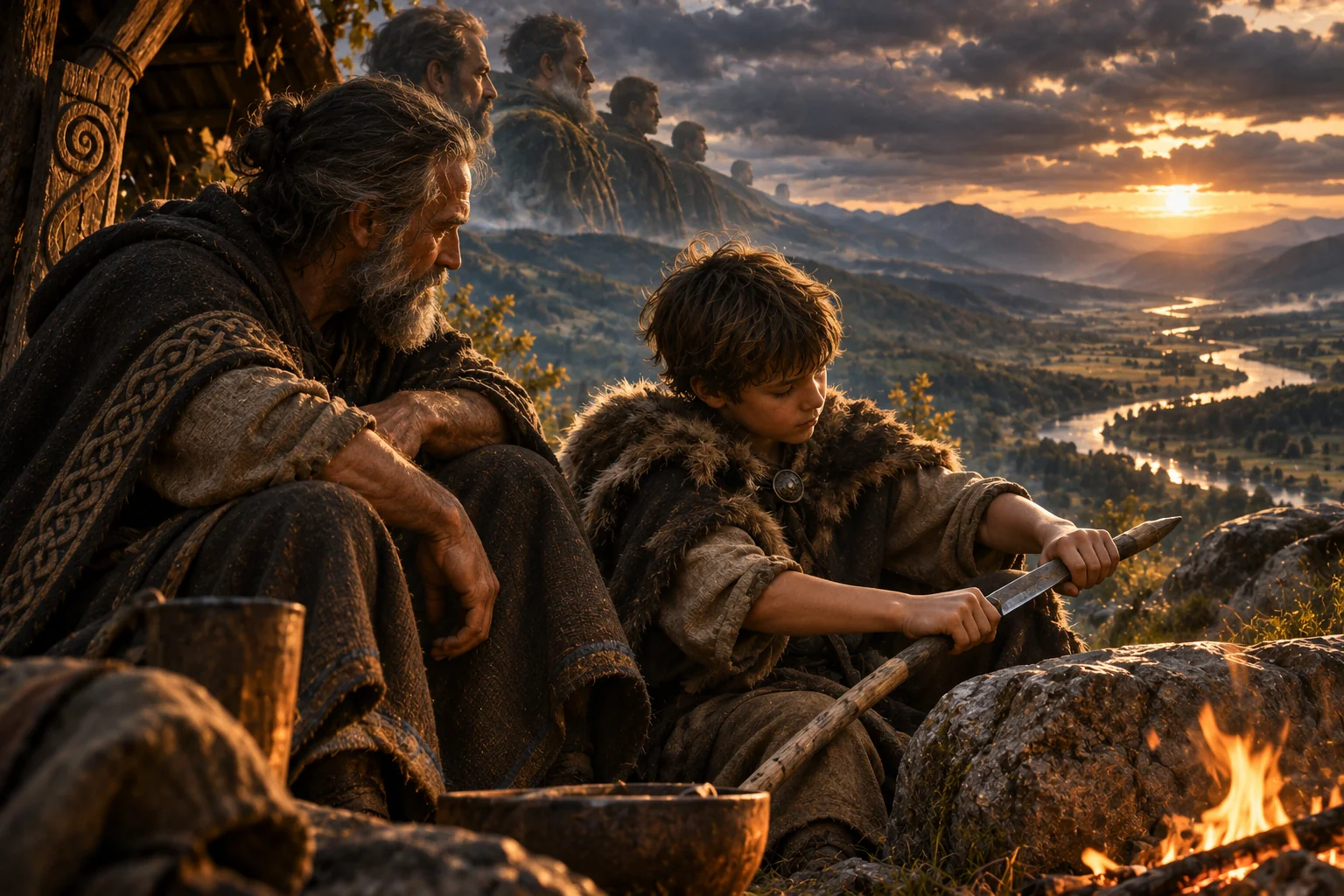
When I was a boy, I believed that the men who had grown old before me possessed some knowledge that the years would eventually grant to me as well. They spoke with a certainty I did not question, performed their duties without apparent hesitation, and carried themselves as though the world had long ago revealed to them the manner in which a man ought to live.
I watched them closely.
I remember their hands, the way they stood, the silences they permitted themselves, and the gravity with which they attended to matters I considered unimportant. Their words seemed to come from a place of settled understanding. Even their anger appeared to possess an authority which my own childish outbursts lacked.
I supposed that age had made them complete.
It did not occur to me that they might still be learning how to be the men I believed them to be.
In those days I imagined manhood as a country beyond the mountains of childhood. One crossed into it by some passage known to the elders, and thereafter belonged to a different order of beings. I did not know precisely when this crossing occurred. Perhaps it came with the first beard, the first blood shed in earnest, the taking of a wife, or the birth of a child. Yet I never doubted that the passage existed, and that those who had crossed it knew something which remained concealed from me.
I have since learned that many peoples understood the necessity of giving this passage a visible form.
They separated the boy from the company of children and placed before him an ordeal. He was required to endure pain, confront danger, keep silence beneath suffering, or perform some deed which frightened him. When the ordeal was completed, the elders received him among the men.
I have often wondered what passed through the mind of such a boy on the morning following his initiation.
The day before, he had trembled before the trial. Now he had endured it. His people called him a man, and duties which had formerly belonged to others were placed upon his shoulders.
Yet surely he still knew fear.
Surely the child who had wished to flee had not vanished entirely in the night.
Perhaps he looked upon his own hands and found them unchanged. Perhaps he waited for some inward transformation to announce that the elders had spoken truly. And perhaps, finding none, he resolved nevertheless to behave as they now expected him to behave.
I suspect that much of human life begins in precisely this manner.
We undertake our obligations before we understand how to fulfil them. We speak with an authority we do not yet possess, imitate gestures whose meaning we only partly comprehend, and perform the duties of men whose certainty we have mistaken for knowledge.
There is something humiliating in this, particularly when we are young.
The novice warrior wears his arms awkwardly. The young father holds his child with a care that betrays his uncertainty. The man who approaches the gods of his ancestors after generations of silence may find the words unfamiliar upon his tongue. He prepares the offering, lights the fire, and speaks the names as faithfully as he can, yet remains troubled by the thought that he is merely imitating a devotion which others once possessed naturally.
I know something of that discomfort.
There are occasions upon which I have performed a gesture inherited from men long dead and wondered whether anything of their understanding remained within it. I have spoken words whose antiquity I respected without knowing whether I possessed the spirit in which they were first spoken.
At such moments the distinction between imitation and sincerity can become painfully difficult to establish.
Yet I have come to doubt whether the men who first taught these gestures to their sons were free from similar uncertainty.
We are inclined to imagine our ancestors as more complete than ourselves.
The warrior of old becomes courage itself. The father becomes wisdom. The priest becomes devotion. Their faults disappear into the distance, while their virtues grow larger with every generation that remembers them.
But the dead were once living men.
They awoke with troubled thoughts, spoke foolishly, regretted their decisions, and sometimes failed when those who depended upon them had expected strength. They must have known fear before battle, doubt before judgment, and bewilderment before the arrival of a child whose life had suddenly become their responsibility.
Some were undoubtedly brave. Others were cowards. Yet I suspect that these distinctions were seldom as permanent as the stories later made them appear.
A man may behave shamefully on one occasion and nobly on another. He may possess courage which remains unknown to him until some unexpected necessity calls it forth. He may also discover, to his lasting sorrow, that a virtue upon which he had confidently relied deserts him at the very moment when it is most required.
I have known enough of life to distrust the notion that a man’s character is a single, unchanging thing.
There are men within us whom we have never met.
Some appear only under suffering. Others emerge in love, anger, grief, or danger. We may spend years cultivating one part of ourselves while remaining ignorant of another, until circumstances reveal a stranger whose face is nevertheless our own.
And so I have begun to wonder whether becoming a man consists less in arriving at some final condition than in learning to bear responsibility for this uncertain company of selves.
The initiated boy does not cease to be afraid. He becomes answerable for what he does while afraid.
The father does not cease to be ignorant. He becomes responsible for a child who cannot wait until his father has acquired wisdom.
The man who honours his ancestors does not suddenly inherit their certainty. He accepts the burden of carrying forward something which he understands imperfectly, knowing that his own failures may become part of its history.
There is no assurance that he will succeed.
This, I think, is what gives the undertaking its seriousness.
It would be comforting to believe that the repeated performance of a noble deed must eventually produce a noble character. But men are capable of repeating the forms of virtue without acquiring its substance. A coward may wear the armour of a hero for many years and still abandon his companions. A man may speak reverently of his ancestors while neglecting the living people entrusted to his care.
The forms alone do not absolve us.
They place a demand upon us.
And perhaps that is their greatest value.
For when a man assumes a role whose obligations exceed his present abilities, he establishes a measure by which his conduct may thereafter be judged. He may fail that measure repeatedly. He may sometimes exceed it. But he can no longer pretend that he does not know what is being asked of him.
I think now of the men I admired in childhood.
I remember how confidently they seemed to occupy their places in the world. I remember believing that their years had brought them to a destination toward which I was still travelling.
Some of them are dead.
Others have grown so old that the strength I once envied has departed from them. Their voices have weakened, their hands tremble, and the judgments which once seemed beyond question have sometimes proved mistaken.
Yet I find that my respect for them has not diminished.
It has merely changed its object.
I no longer admire them because I believe they were free from uncertainty. I admire them, where admiration is deserved, because they carried their obligations while possessing no greater assurance of their own adequacy than I possess of mine.
They were not finished men.
They were men who continued.
And now I have reached an age at which younger people sometimes look upon me with an expectation I recognise from my own childhood.
They ask questions as though I must know the answers. They observe my conduct, repeat my expressions, and occasionally imitate habits which I had scarcely noticed in myself.
I find this disconcerting.
For I know how much uncertainty remains within me. I know the occasions upon which I have been cowardly, foolish, impatient, or unjust. I know how often I have acted with confidence while privately doubting whether I understood the matter before me.
I have waited a great many years to become the man I once imagined adulthood would make of me.
I am no longer certain that such a man exists.
And yet the years have passed, duties have been undertaken, children have been born, and the dead have been remembered. I have performed rites which I hope my children may one day understand more fully than I do. I have repeated words spoken by men whose names are forgotten, and have sometimes found in them a gravity which I could not have supplied from my own understanding.
I have also failed.
I expect that I shall fail again.
There is no elder waiting to declare that my becoming is complete. No ordeal whose successful conclusion will remove the contradictions of my nature. No final morning upon which I shall awaken permanently courageous, wise, or worthy of the men whose example I have attempted to follow.
Perhaps I once believed that the ancestors had reached such a morning.
I do not believe it now.
I think instead that each generation received from the preceding one a collection of duties, gestures, stories, and expectations which no individual had ever perfectly fulfilled. The living took them up, altered them through their own conduct, and eventually surrendered them to those who followed.
Some carried them well.
Others carried them badly.
But none carried them forever.
And it occurs to me that the continuity of a people may depend less upon the perfection of its ancestors than upon the willingness of imperfect descendants to undertake their unfinished work.
I remember once watching an older man perform some ordinary task. I cannot now recall what the task was, only the assurance of his movements and the impression they made upon me.
For years afterward I imitated something of his manner.
I did not know that I was doing so.
Only much later, when I recognised the same movement in my own hands, did I remember where I had learned it.
The man was already dead.
I wondered then from whom he had learned it, and whether that earlier man had likewise believed himself merely imitating someone older.
I have no means of answering these questions.
But I sometimes watch the young now, and see them attempting to assume the bearing of men before they have acquired the years which they imagine will justify it.
Their efforts can be awkward. Their confidence is often borrowed, and their gestures sometimes betray the very uncertainty they wish to conceal.
I recognise something of myself in them.
And when I am tempted to smile at their imitation, I remember the men who stood before me when I was young, and wonder whether they too had recognised the same thing.
For I have lived long enough to see that the boy does not disappear when the man arrives, nor does the man cease becoming when his hair turns grey.
The years merely place more upon his shoulders.
And somewhere behind him, another boy is watching.